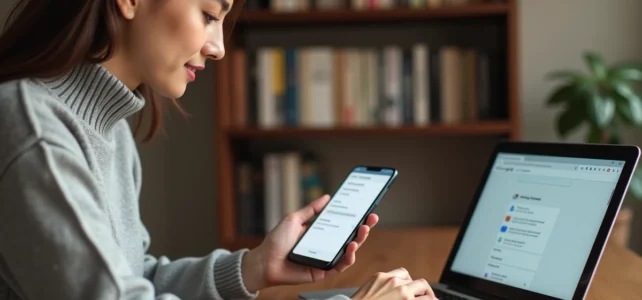
Google synchronization links a single account to multiple devices (phone, tablet, Chromebook, desktop browser) to keep contacts, calendar, passwords, and files up to date. The mechanism seems simple on the surface, but the layers added since Android 14, GDPR, and the Digital Markets Act have changed what synchronization actually transports between your devices.
What Google synchronization transports beyond contacts and calendar
Most guides limit themselves to classic data: Gmail, contacts, calendar, photos. Since Android 14 and recent versions of Google Play Services, synchronization also covers advertising privacy preferences. Specifically, settings related to advertising identifiers and activity tracking are harmonized across all devices connected to the same account.
Google uses this channel to consistently enforce your ad personalization choices, whether you are on your Android phone or on a Chromebook. If you disable personalization on one device, the setting propagates to the others.
This extension of the synchronization scope has a direct consequence: enabling synchronization no longer just means accessing your emails everywhere. You also share a unified advertising profile with Google. Knowing precisely how to enable Google synchronization therefore involves understanding what flows between your devices before checking the boxes.
Granularity of synchronization settings on Android
Since the changes imposed by the GDPR and the European DMA, Google has revamped the account management interface for users in the European Union. Synchronization options related to web activity, location history, and ad personalization are now presented separately with explicit consent screens.
On an Android phone, the path remains Settings, then Accounts, then your Google account. There, you access the list of synchronized applications. Each application has its own individual switch.
What you can disable without breaking useful synchronization
The current granularity allows you to keep synchronization of contacts and calendar while turning off that of Google Play, Chrome, or Gmail. The items you can manage independently include:
- Gmail data (messages, labels, inbox settings), useful if you prefer an alternative mail client on a specific device
- Chrome synchronization (passwords, history, open tabs), which can be disabled on a shared workstation without affecting the phone
- Google Drive files, whose background synchronization consumes mobile data if it remains active continuously
- Location history and web activity, now separated from other synchronization streams in the European interface
Disabling global automatic synchronization remains possible. In this case, no data is transferred automatically: you must manually trigger each update from the account settings.
Google synchronization on desktop browser and Chromebook
On Chrome for Windows, macOS, or Linux, synchronization goes through the Chrome profile linked to your Google account. Enabling synchronization in the browser groups passwords, bookmarks, installed extensions, history, and open tabs.
The often overlooked point concerns passwords saved in the Google manager. They synchronize between mobile Chrome and desktop Chrome as soon as both are connected to the same account. If you use a third-party password manager, this double synchronization can create duplicates or version conflicts.
Special case of the Chromebook
On Chromebook, Google synchronization is enabled by default upon account login. The entire system relies on this permanent link. Turning off synchronization on a Chromebook drastically limits functionality: no automatic backup of settings, no quick recovery in case of reset.
However, this total dependence also means that any data deleted on the Google server disappears from the Chromebook at the next synchronization. Deletion propagates both ways, which requires particular vigilance before cleaning an account.

Known limits and friction points of multi-device synchronization
Google synchronization works well in a homogeneous ecosystem (Android plus Chrome plus Chromebook). Field feedback diverges on this point as soon as an Apple device or a third-party browser enters the loop.
Google Photos illustrates this discrepancy. On Android, photo synchronization can be configured to work only over Wi-Fi. On iOS, the Google Photos app operates alongside the iCloud photo library, which generates duplicates if both services remain active simultaneously.
Data and battery consumption
Automatic synchronization regularly engages the network connection and the processor. On a phone with a limited data plan, the combined flows of Gmail, Drive, and Photos can consume a significant volume each month. Disabling automatic synchronization for data-hungry applications and switching to manual synchronization reduces this consumption without losing access to data.
The battery experiences the same effect. Each synchronization cycle wakes the device, queries Google servers, and updates local data. Multiplied by a dozen synchronized applications, the impact on daily battery life is measurable.
Version conflicts and overwritten data
Modifying a contact or calendar event on two devices simultaneously can cause a conflict. Google generally applies the rule of the last change recorded on the server. The available data do not allow for concluding that an intelligent merging mechanism exists for all types of data: for contacts, Google attempts a merge, but for simultaneously modified Drive files, a conflict copy is created.
Before enabling synchronization on a new device, check that the data present locally on that device will not overwrite more recent information stored on the server. Manually backing up before the first synchronization remains the most reliable precaution.
Google synchronization offers real comfort when configured precisely. Enabling it en masse without examining each stream means accepting a permanent transfer of data whose scope far exceeds emails and contacts. Taking the time to review each switch in the account settings, application by application, remains the only way to maintain control over what flows between your devices.