
China occupies a unique place in the global flow of information. Amid trade tensions with the United States, technological acceleration, and profound social changes, following Chinese news requires sorting through sometimes contradictory signals. Recent developments surrounding Donald Trump’s visit to Beijing, negotiations over Taiwan, and the race for artificial intelligence place the country at the center of several simultaneous geopolitical fault lines.
Chinese Regulation of Generative AI: A Tightening Framework
Competitors extensively cover diplomacy and trade. Less visible but equally structuring is the regulatory framework that Beijing has imposed on generative artificial intelligence since the regulation came into effect on August 15, 2023.
Three cities, Beijing, Shanghai, and Shenzhen, have been designated by the Ministry of Science and Technology as pilot zones. These “regulatory testing grounds” allow companies to deploy large language models under prior supervision from the Cyberspace Administration of China (CAC). The principle: to permit experimentation, but within a controlled perimeter.
Since 2024, the interpretation of the regulation has significantly tightened. Several platforms have received warnings for content deemed inconsistent with socialist values. The boundary between innovation and control remains blurred, and field reports diverge on the actual leeway available to Chinese developers on a daily basis. Analyses published on https://www.cnblog.org/ provide continuous updates on these regulatory and societal developments.
Trump’s Visit to Beijing and Trade Agreements: What Has Changed
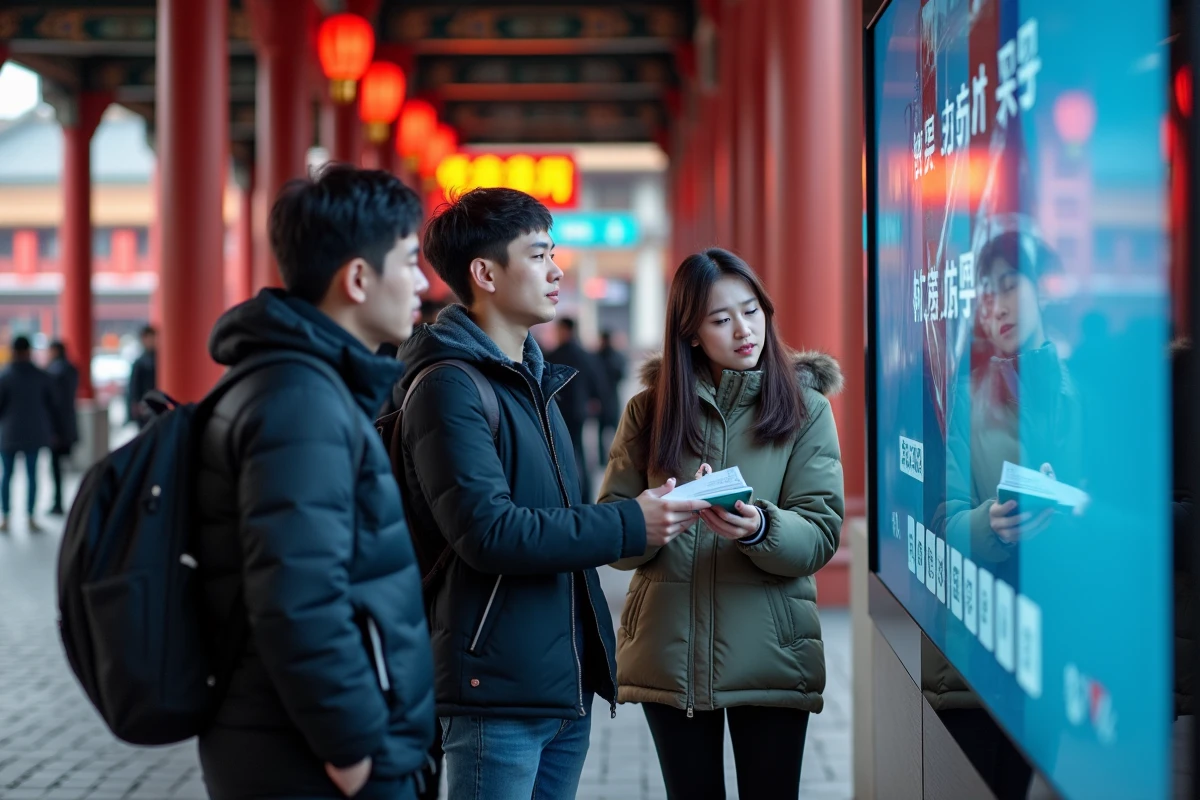
Donald Trump’s visit to China drew media attention to several simultaneous topics. The American president claimed to have reached “fantastic” trade agreements with Xi Jinping, while both countries committed to implementing “all” existing trade agreements.
Behind the statements, the commercial reality remains more nuanced. French companies exposed to the Chinese market face a double uncertainty: the trade war between Washington and Beijing is altering supply chains, and fluctuating tariffs complicate any medium-term planning.
On the industrial side, the partnership between Stellantis and the Chinese Dongfeng to produce Peugeot and Jeep in China illustrates an underlying trend. Western manufacturers are no longer just looking to sell in the Chinese market: they are relocating part of their production locally to circumvent tariff barriers and remain competitive against Chinese brands.
Taiwan at the Heart of Strategic Tensions Between China and the United States
Xi Jinping warned Donald Trump about the risk of conflict regarding Taiwan during their summit. Taiwan responded by reaffirming its status as an independent nation and reminding the United States of its commitment to arms sales.
This issue goes beyond the bilateral Sino-American framework. Taiwan concentrates a major share of global advanced semiconductor production. Any military or diplomatic escalation around the strait would have direct repercussions on global technological supply chains.
China maintains a posture of calculated ambiguity regarding the timeline for potential reunification. The available data do not allow for a conclusion as to whether the recent military maneuvers in the strait represent a change in doctrine or a show of force for internal use.
Chinese Society and Demographics: The Weak Signals to Watch
The aging Chinese population is regularly mentioned in the mainstream press. What is less discussed is the pro-natalist shift initiated since 2023-2024 by several major cities.
Shenzhen, Guangzhou, and Hangzhou have implemented concrete measures:
- Direct allowances paid at birth, with amounts varying by municipality
- Extended parental leave for both parents, beyond the national minimum
- Housing subsidies targeting young couples with children
These measures reflect a strategic shift. Beijing is moving from a restrictive logic to an openly pro-natalist policy, but the effects remain difficult to measure. Birth rates in these pilot cities have not yet shown a significant rebound, and the economic pressure on urban households (housing costs, education) hinders parenting intentions.
The persistence of the social effects of the “zero-Covid” policy also complicates the picture. Several analysts note that post-pandemic challenges continue to influence consumption behaviors and life choices among young Chinese.

Asian Markets and Chinese Growth: Ongoing Economic Dynamics
Asian markets have shown solid performance in recent months. Chinese growth, although slowing compared to the previous decade, remains a driver for the entire region.
Several factors support this dynamic:
- The development of “new quality productive forces,” Beijing’s official term for investment in cutting-edge technologies (batteries, electric vehicles, AI)
- Domestic consumption, which the government is trying to stimulate to reduce dependence on exports
- Upcoming tax reforms, the precise contours of which remain unclear but aim to redistribute resources between wealthy provinces and less developed ones
Opportunities for foreign companies exist, but under conditions. Access to the Chinese market comes with increasing regulatory constraints, sometimes imposed technology transfers, and increasingly aggressive local competition. Putin’s visit to Beijing, scheduled a few days after Trump’s, reminds us that China is playing on multiple diplomatic fronts simultaneously.
Following Chinese news in 2025 requires cross-referencing readings: trade, technology, demographics, and geopolitics intertwine. Official announcements from Beijing or Washington are not sufficient to grasp the underlying movements. Regulatory transformations around AI, the pro-natalist shift in major cities, and post-trade war industrial reshuffles outline a rapidly changing China, the effects of which extend well beyond its borders.