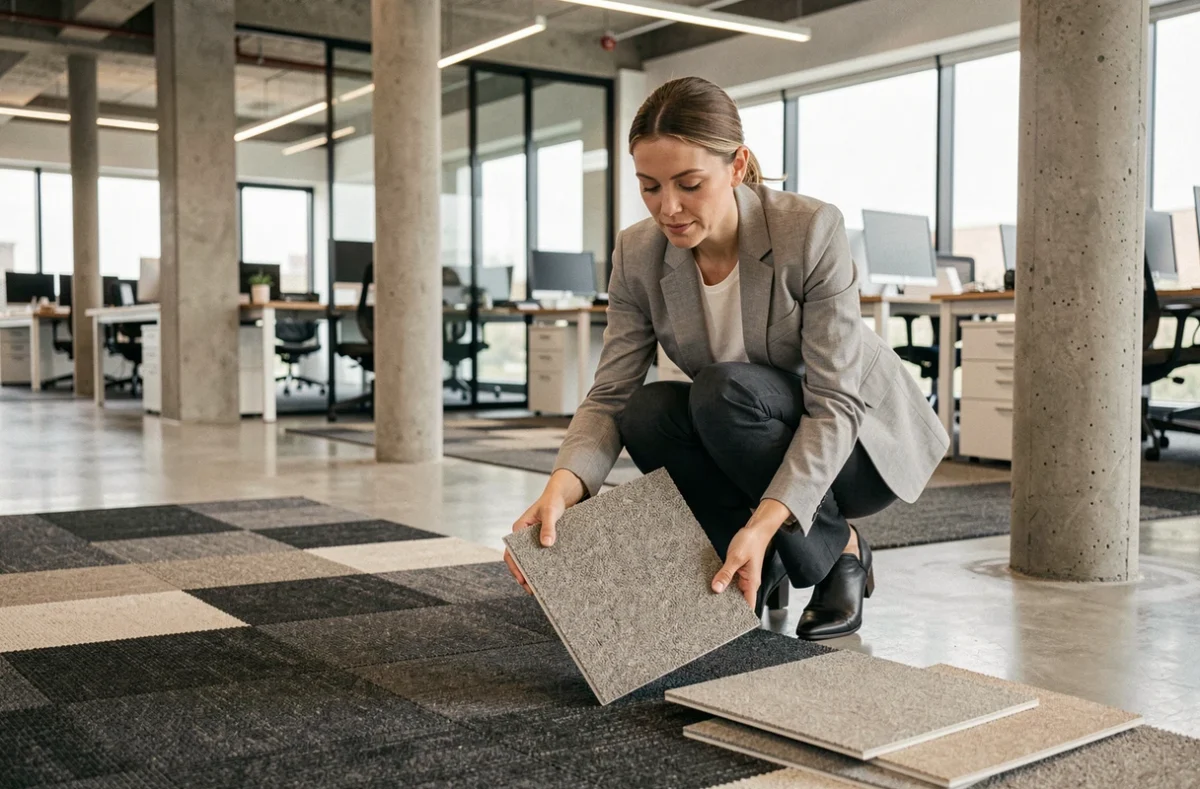
A floor in an office or meeting room that starts to buckle after a few months, or a tile that lifts under the wheels of a mail cart: the problem rarely lies with the carpet itself, but with a selection criterion that was overlooked from the outset.
Loose-lay carpet tiles stay in place under their own weight, without adhesive or clips. This simple principle involves several technical factors that can make the difference between a durable floor covering and a project that needs to be redone.
Bitumen backing and weight per square metre: what keeps loose-lay tiles in place
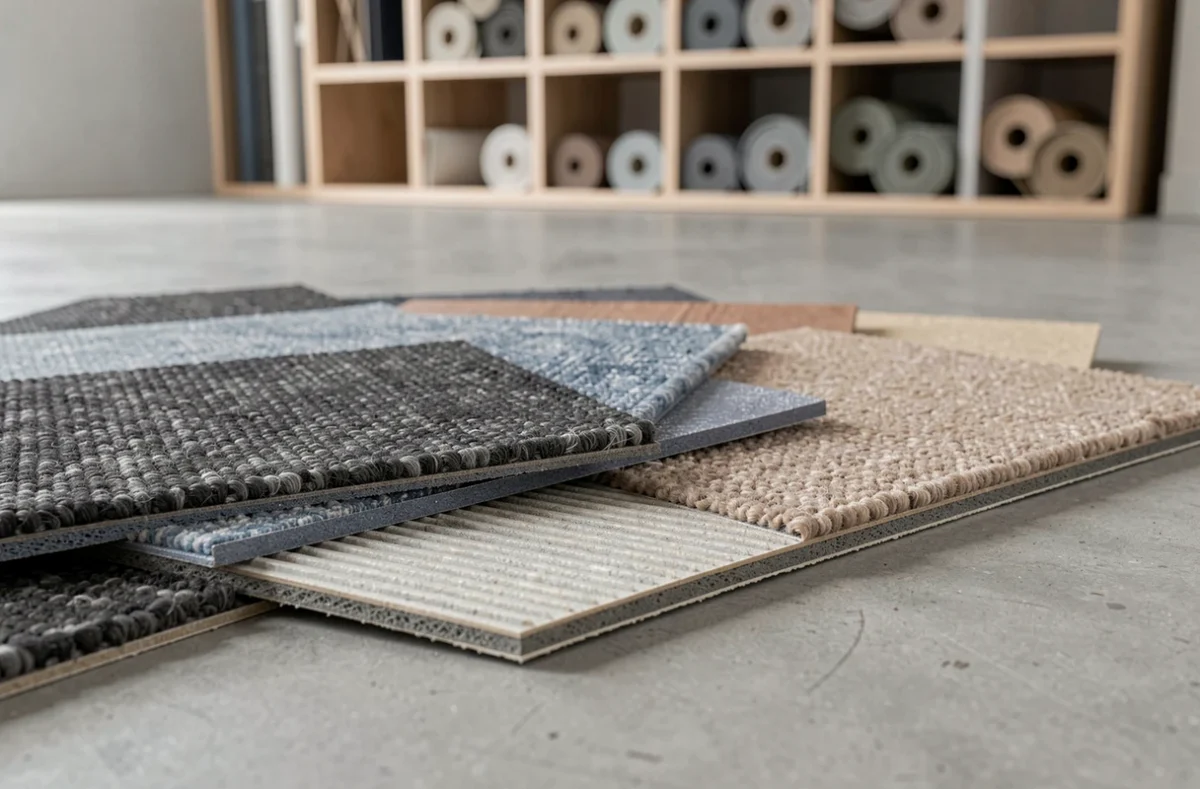
The term “loose-lay” refers to the weight of the backing. The tile’s bottom layer, usually made of filled bitumen, gives it enough density to stay flat on the floor without being fixed in place. This ballast takes the place of adhesive.
Have you ever noticed how a cheap tile slips underfoot while another of the same size seems bonded to the subfloor? The difference comes down to the density of the backing. A backing that is too light will not keep the tile stable under foot traffic. If a manufacturer does not provide the backing’s weight per unit area, consider it a warning sign.
Before choosing loose-lay carpet tiles, check that the technical data sheet lists the total weight and backing weight separately. Total weight includes the pile, so it may look reassuring even when the backing is not heavy enough.
Use classification and actual foot traffic: match the tile to the space
The UPEC classification, used in France for floor coverings, rates resistance to wear (U), indentation (P), water (E) and chemicals (C). For loose-lay carpet tiles intended for offices, the U and P ratings are the most important.
Moderate-traffic offices or busy corridors
A partitioned workspace with a few fixed desks does not put the same demands on carpet tiles as a reception corridor crossed hundreds of times a day. A U3 P2 rating covers most standard commercial applications. For a lobby or a busy open-plan office, choosing the next U rating up can help prevent premature replacement.
Indentation resistance (P) matters just as much as wear resistance. Office chair casters, metal furniture legs and carts create concentrated pressure that crushes the pile and deforms the backing. A P3-rated tile withstands this kind of stress better than a P2-rated one, even if the surface pile looks identical.
Check that the rating matches actual conditions
A high rating on the product sheet does not eliminate the need to check the condition of the subfloor. An uneven screed, a dusty floor or excessive residual moisture can undermine the stated performance. The flatness of the subfloor affects how well the tiles stay in place just as much as their own weight.
Acoustic comfort and air quality: two often-overlooked factors
For office or shared-space fit-outs, loose-lay carpet tiles offer an advantage that PVC or vinyl cannot provide as easily: impact sound absorption. Footsteps, moving chairs and dropped objects are all softened by the textile pile and the thickness of the backing.
Why does this matter so much? Because floor noise is the leading source of measured disturbance in open-plan offices. A tile with good acoustic performance (measured in decibels of impact sound reduction) can make a noticeable difference to the atmosphere across an entire floor.
A+ rating: useful, but not enough
The A+ rating measures volatile organic compound emissions under laboratory conditions. It does not account for any underlay or the product used to prepare the subfloor. For projects where indoor air quality is a priority—such as nurseries, healthcare facilities or poorly ventilated enclosed spaces—it is worth asking the supplier for emissions data for every component being installed, not just the tiles.
Loose-lay carpet tiles and end of life: factor in the cost from the start
Easy removal is a common selling point: lift a tile and replace it. In practice, one question is rarely asked next: what happens to the removed tiles?
In France, the extended producer responsibility (EPR) scheme for construction products and materials requires manufacturers to contribute to waste management. The practical take-back arrangements vary by supplier and local waste-sorting systems. Before placing an order, it is worth asking three questions:
- Does the supplier offer to take back tiles at the end of their service life, and what logistical conditions apply?
- Can the tiles be recycled through a textile recycling stream, or will they be sent to landfill?
- Is an environmental product declaration (FDES) available for the exact product reference being considered, and does it cover the end-of-life stage?
A supplier that provides a verified FDES for the exact product reference makes it possible to compare products reliably beyond price per square metre alone.
Key selection criteria for a loose-lay tile project
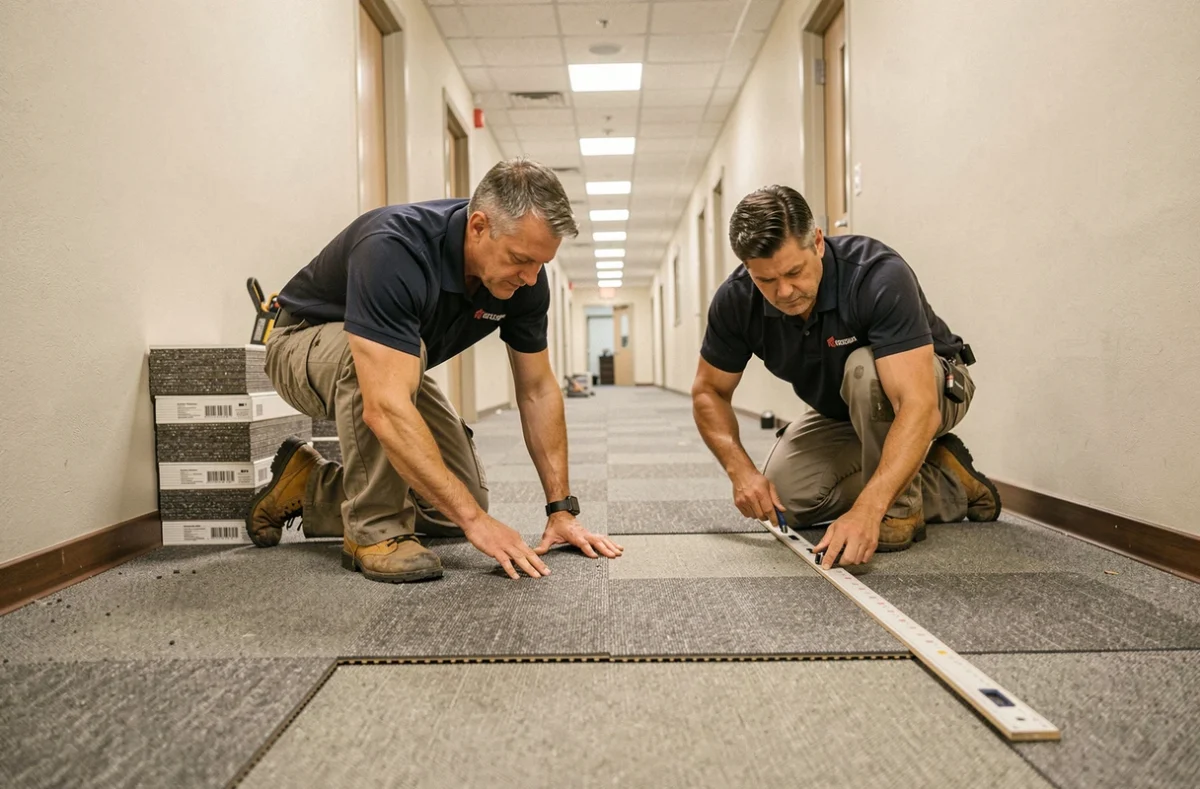
Rather than an exhaustive checklist, here are the key points to check to avoid the most common mistakes:
- Bitumen backing weight listed separately from total weight on the technical data sheet
- UPEC rating suited to the space’s actual foot traffic (not the theoretical traffic of a model office)
- Acoustic reduction measured in decibels, rather than simply described as “good sound insulation”
- VOC emissions data available for both the tiles and the product used to prepare the subfloor
- End-of-life take-back arrangements confirmed by the supplier before ordering
Choosing loose-lay carpet tiles comes down to the technical data sheet, not the colour chart. Colours and pile textures shape the look of the project, but the backing, classification and environmental data determine whether the floor will deliver on its promises over time.