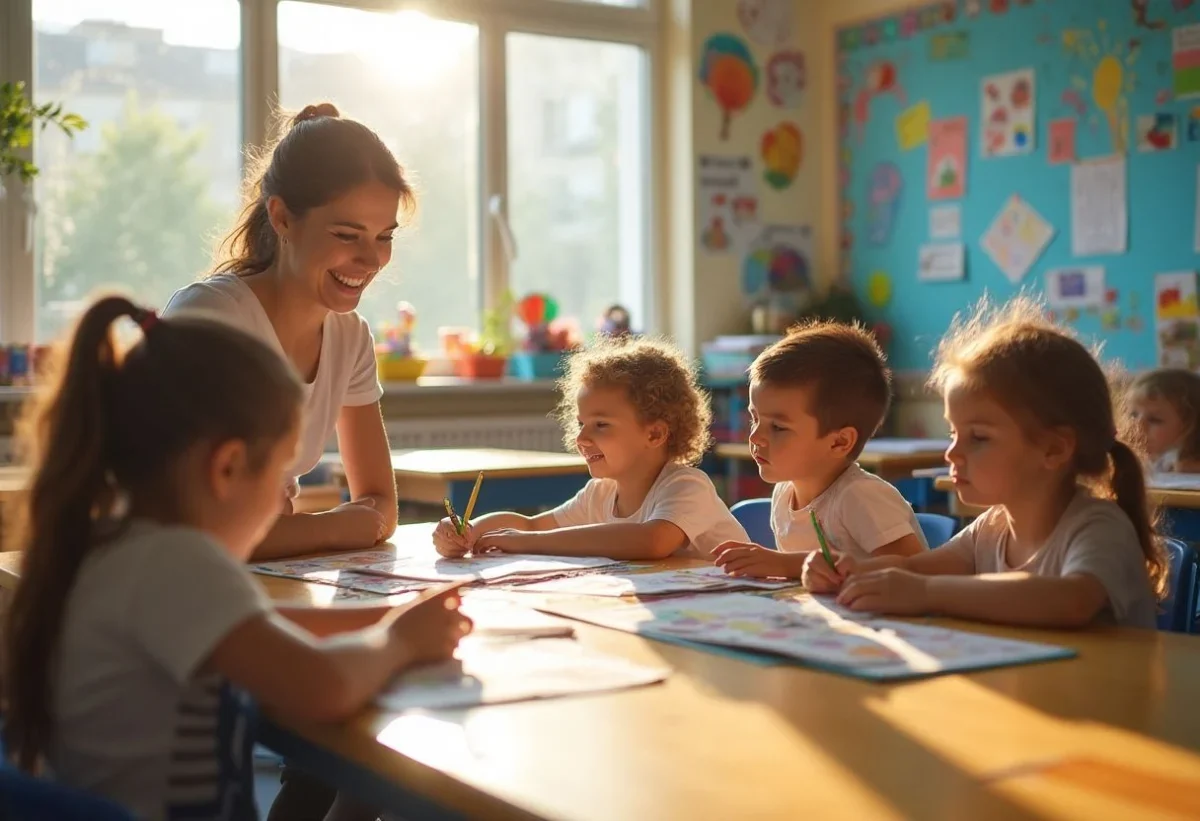
The teaching of mathematics in primary school lays the essential foundations for the development of logical thinking and problem-solving skills in children. Through diversified methods and innovative pedagogical approaches, mathematics classes aim to make math accessible and engaging for all students.
Importance of Mathematics in Children’s Lives
Mathematics plays a crucial role in children’s daily lives. It not only enhances calculation skills; it also develops logic, critical thinking, and problem-solving abilities. In primary school, the teaching of mathematics prepares each child to face life’s challenges and to understand the world around them.
Objectives of Mathematics Teaching in the Classroom
The teaching of mathematics in primary school aims to spark children’s interest in math from their very first classes. Objectives include acquiring basic calculation skills, understanding fundamental mathematical concepts, and the ability to apply these skills to practical situations.
The Different Mathematical Concepts Taught
The Basics of Calculation: Addition and Subtraction
From the very beginning of their school journey, children learn the basics of calculation, including addition and subtraction. These concepts are introduced through games and playful activities that facilitate learning. Activities such as counting objects or using colored cubes stimulate students’ interest and make classes more interactive.
Multiplication and Division: Pedagogical Methods
Later in their learning, children are introduced to multiplication and division. These operations are often taught through innovative methods, such as Montessori pedagogy, which emphasizes the manipulation of objects to aid in understanding complex concepts. The Montessori approach encourages children to explore and discover math on their own, thereby stimulating their natural curiosity.
Geometry in Primary School
Introduction to Geometric Shapes
Geometry is introduced in primary school through the study of simple shapes, such as circles, squares, and triangles. Children learn to recognize and draw these geometric figures, thereby developing visual and spatial understanding. This stage is essential for the application of mathematics in everyday life.
Applications of Geometry in Daily Life
Geometry concepts teach children to see mathematics in their environment. Whether it’s understanding patterns in clothing or identifying shapes in buildings, geometry offers them a new perspective on the world, reinforcing their mathematical culture.
Mathematical Problems and Problem Solving
Problem-Solving Methods Applied in Class
Problem-solving is at the heart of math learning. In primary school, children are encouraged to use trial and error to solve problems. This method, recommended by Freinet pedagogy, promotes autonomy and creativity in the classroom.
Importance of Problems in Learning Mathematics
Mathematical problems allow children to put their acquired knowledge into practice. They develop essential skills such as logic, analysis, and decision-making. These skills are crucial not only in the school context but also in their future lives.
Pedagogical Approaches to Teaching Mathematics
Montessori Method and Its Impact on Learning
The Montessori method, with its principles of autonomy and manipulation, has a significant impact on mathematics learning in primary school. It allows children to progress at their own pace, respecting their natural development and reinforcing their self-confidence.
Freinet Pedagogy for a Collaborative Approach
Freinet pedagogy emphasizes collaboration between students and the teacher. Through collective projects and open discussions, this method fosters participatory learning that enriches children’s school experience.
Resources and Tools for Mathematics Teachers
Websites and Applications for Teachers and Students
Many websites and applications, such as pass education, offer valuable resources to facilitate the learning and teaching of mathematics. These digital tools provide access to a variety of educational materials tailored to the specific needs of students.
Using the School Journal to Track Progress in Math
The school journal is a valuable tool for tracking students’ progress in mathematics. It allows teachers to record each child’s successes and challenges, thereby fostering continuous and personalized assessment. This approach ensures effective monitoring of mathematics teaching and learning in primary school.