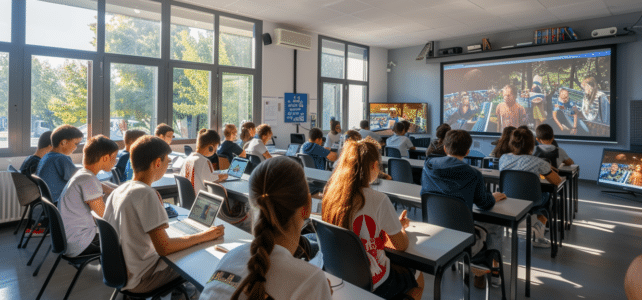
In Breton high schools, the adoption of digital tools within pedagogical practices has become an essential component of modern teaching. This transition to digital has accelerated, particularly under the impetus of national programs aimed at reducing the digital divide and preparing students for the challenges of the information society. Teachers are now integrating online learning platforms, educational applications, and interactive devices that enrich the learning experience. However, this shift raises questions regarding equipment, teacher training, and equal access for all students.
Impact and integration of digital tools in Breton pedagogical practices
The Breton educational landscape has undergone a significant transformation with the integration of digital technologies at the heart of teaching methods. The digital tools, which have become indispensable, have multiplied in classrooms, driven by the teachers themselves. At the Vauban polyvalent high school in Brest, for example, the use of tablets has revolutionized the pedagogical approach, facilitating access to digital resources and fostering a more dynamic interaction between students and teachers. The regional authority, the Brittany Region, has not remained on the sidelines of this movement, actively supporting digital experiments that pave the way for a more interactive and personalized education.
The lockdown has exacerbated the need for a rapid adaptation to these new tools. In this context, digital workspaces (ENT), such as pronote Saint-Jo Lorient, have taken a central place in the daily life of high schools, allowing for pedagogical continuity despite the closure of institutions. Arnaud, an innovative teacher, did not hesitate to use the Moodle Box to maintain the connection with his students, thus ensuring a smooth transition to more autonomous and responsible digital practices.
However, the integration of digital tools faces challenges, particularly in terms of equipment and teacher training. Nevertheless, digital practices in education in Brittany are becoming a model for developing critical and creative skills, essential in the information society. The convergence of individual initiatives and institutional support seems to chart the way towards a Breton education resolutely oriented towards the future, where digital resources are both a vector for equal opportunities and an asset for knowledge acquisition.

Perception and adaptation of educational communities to digital technology
Within Breton high schools, educational communities have faced the challenge of adapting to digital technology, a transformation that has not been without its difficulties. Gilles Bénic, a seasoned teacher, points out a palpable digital divide, not only between institutions but also within the classes themselves. This disparity calls for deep reflection on the modalities of equipment and training, in order to ensure equitable access to digital educational resources.
Isabelle Pellerin, a pedagogical manager, has gathered the reactions of teachers. Between enthusiasm and reluctance, the spectrum of attitudes illustrates the diversity of perspectives on the integration of digital technologies. For some, the digital age represents an opportunity to renew teaching methods; for others, it carries the risk of increasing workload and complicating educational tasks.
The Ministry of National Education has spared no effort, implementing a support policy aimed at minimizing the divide and promoting digital skills among teachers and students. Continuous training programs and investments in classroom equipment have been deployed, in the hope of making digital a lever for equality and pedagogical innovation.
Anne Orhon, a media education specialist, emphasizes the urgency of integrating media education into school curricula. Mastery of digital technology, beyond the use of digital workspaces, involves a critical understanding of tools and content. It is in this perspective that Josselin, a TICE trainer, intervenes in institutions to raise awareness among educational communities about the challenges of digital technology and to equip stakeholders to face the challenges of tomorrow.