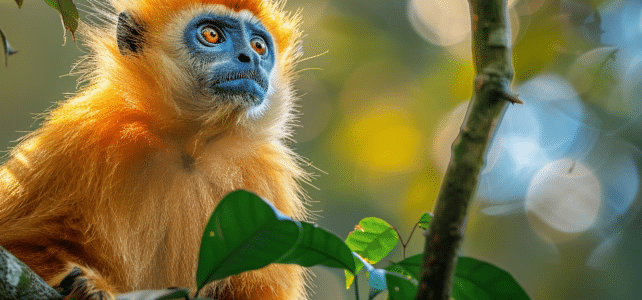
On our planet, the primate family stands out for its extraordinary diversity, reflecting adaptation to varied habitats and lifestyles. Some species stand out due to their striking characteristics, whether unique behaviors, astonishing physical traits, or their rarity. From tarsiers with disproportionate eyes to proboscis monkeys with prominent noses, and the ghostly lemurs of Madagascar, these unusual primates are wonders of evolution. Their study offers fascinating insights into biological adaptability and raises major questions about conservation in the face of environmental threats.
Discovering the Most Unusual Primates
The list of the 25 most endangered primates in the world serves as a wake-up call for the scientific community and the general public. Published every two years, this enumeration, the result of the joint efforts of the Primate Specialist Group of the Species Survival Commission, the International Union for Conservation of Nature, the International Primatological Society, Conservation International, and the Bristol Zoological Society, aims to draw attention to primate species and subspecies that require urgent conservation measures.
Among the primates whose survival is threatened, the Tapanuli orangutan, located in Sumatra, Indonesia, and the Bornean orangutan, found in Borneo, Malaysia, and Indonesia, stand out. These creatures, known for their attentiveness and patience, as well as their ability to use tools to solve problems, embody the cognitive complexity of our closest relatives. Their status as ‘endangered’ confirms the fragility of their existence in the face of human activities.
The forests of Southeast Asia resonate with the melodies of gibbons, great apes known for their harmonious songs used to mark their territory. These tree acrobats illustrate another facet of primate ingenuity. In Africa, the gorilla, the largest of all great apes, is recognized for its gentle and peaceful nature, organized into complex social groups led by a dominant male.
Africa is also home to the chimpanzee, known for its ability to make and use tools and for its remarkable memory, just like the bonobo, famous for its use of sexual relationships as a conflict resolution mechanism within its matriarchal society. One of the most astonishing representatives of primate diversity may be the ‘red-bottomed monkey’, whose common name reflects the morphological eccentricity that evolutionary adaptation can take. These primates, distributed across several regions of the world, reflect the biological richness that our planet has to offer and the necessity to preserve each species, no matter how unusual it may be.

The Conservation Challenges of Unique Species
Deforestation, one of the predominant threats, leads to a drastic reduction of the natural habitat of primates and an invaluable loss of biodiversity. Tropical forests, complex ecosystems and cradle of wildlife, are being cleared at an alarming rate to make way for agriculture or logging, thereby reducing the territories where these species can thrive. Be aware of the direct impact of deforestation: it threatens not only primates but also the overall ecological balance.
Poaching represents another significant challenge. This scourge, fueled by illegal trade, decimates primate populations, which are hunted for their meat, skin, or to be sold as pets. The fight against this illegal practice requires constant vigilance and the implementation of repressive measures.
Diseases are a significant factor in the struggle for primate conservation. The transmission of pathogens between humans and animals can have disastrous consequences, sometimes leading to epidemics within already vulnerable populations. This issue underscores the importance of environmental health and the necessity of maintaining a barrier between human activities and primate habitats.
In the face of these challenges, conservation takes multiple forms. Reforestation emerges as a means to restore destroyed natural habitats, while legal protection serves as a bulwark against destructive practices. Public education and awareness play a fundamental role, as understanding the intrinsic value of these living beings and their environment is the first step towards a commitment to their preservation. These concerted actions, although complex, are essential to ensure the sustainability of the most unusual primate species on our planet.