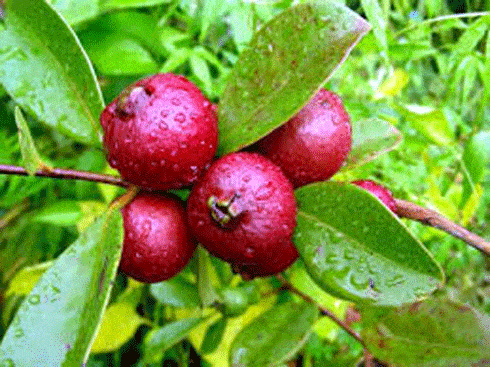
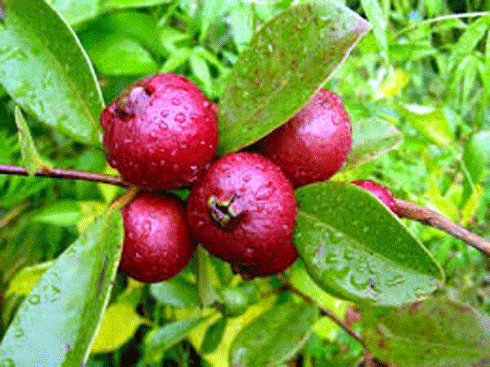
As the decision-making authority at the borders, customs officers do not necessarily have the required expertise regarding exotic and/or invasive plants. This means that countries are either voluntarily or involuntarily welcoming species that pose a threat to their ecosystem. Classified as invasive plants, Chinese guavas are found everywhere in Madagascar. In
Environmental conservation through measures aimed at preventing invasive species and exotic species. This is the main objective of the workshop on exotic and invasive plants taking place until August 10 at the Tana Antaninarenina Hotel. An initiative that is part of the biodiversity project of the Indian Ocean Commission (IOC) and funded by the European Union. Ensuring the limitation of the entry of plants described as exotic and invasive by coordinating the control actions carried out by the various entities at the borders is one of the many challenges faced by the different control entities. In the case of Grande-Île, exotic and invasive plants exist in large numbers. In addition to destroying the ecosystems where they are planted, invasive plants also disrupt the nature of the soil (through acidification). They are therefore risk factors for the country’s endemic species. Especially since once they are established in an area, it is difficult to eradicate them. Although there are regulations — international and/or national — the various control agents struggle to ensure the impermeability of the borders.
Challenges Limiting the export of these species through better border controls. A concern that should be ongoing among control agents (agriculture, environment, phytosanitary control, or forestry) at the borders, if environmental protection is a priority for countries like Madagascar. However, these different entities may lack the knowledge and skills necessary to control the entry of the plants in question. Many border agents may not know what an invasive plant is or the dangers it poses. Initiatives aimed at strengthening the capacity of these countries – including customs agents empowered to decide whether plants can enter IOC member countries — should be undertaken. Furthermore, while it is difficult to stem the tide of invasive plants, exploiting them as is already done with bamboo would be an option not to be overlooked. A farm that would not be beneficial without the species described as invasive is neither listed nor cataloged. But also without the space being developed in a way that preserves other endemic species.
JoseBelalahy
Tag : the bird of paradise